
Technical Program
This page shows the WiOpt 2026 program, including program at a glance, conference maps, and detailed program.
- Main conference (June 3-5): Room 130
-
Workshops (June 6):
- MOSC - Room 270
- RAWNET+ISAC - Room 260
| Time | Day 1 - Wed (Main) | Day 2 - Thur (Main) | Day 3 - Fri (Main) | Day 4 - Sat (Workshop) | |
|---|---|---|---|---|---|
| 07:00AM - 08:00AM | Registration and Breakfast | Registration and Breakfast | Registration and Breakfast | Registration and Breakfast | |
| 08:00AM - 08:30AM | Opening Session |
MOSC (08:00AM - 10:30AM) |
RAWNET (08:00AM - 09:20AM) | ||
| 08:30AM - 09:50AM | Session 1A: Bandits and Online Learning | Session 2A: Edge Computing and Offloading | Session 3A: Network Control and Scheduling | ||
| 09:50AM - 10:00AM | Break | Break | Break | ISAC (09:30AM - 10:30AM) | |
| 10:00AM - 11:00AM | Keynote 1 | Keynote 2 | Keynote 3 | ||
| 11:00AM - 11:30AM | Coffee break | Coffee break | Coffee break |
Coffee break (10:30AM - 11:00AM) |
|
| 11:30AM - 12:50PM | Session 1B: Age of Information | Session 2B: Resource Allocation and Network Optimization | Session 3B: Reconfigurable Intelligent Surface |
MOSC (11:00AM - 12:20PM) |
ISAC (11:00AM - 12:40PM) |
| 12:50PM - 02:30PM | Lunch Break | Lunch Break | Lunch Break | Lunch Break | |
| 02:30PM - 03:50PM | Session 1C: Emerging Topics: Quantum, Haptic Communication, and ISAC | Session 2C: 5G/6G and Beyond | Session 3C: Network Economics and Incentives | ||
| 03:50PM - 04:20PM | Coffee Break | Coffee Break | Coffee Break | ||
| 04:20PM - 05:40PM | Session 1D: Federated Learning | Session 2D: Semantic and Efficient Communications | Session 3D: Learning for Wireless Systems | ||
|
Reception (05:40PM - 07:30PM) Location: Conference Building |
Banquet (07:00PM - 10:30PM) Location: Sow Plated |
Closing Session (05:40PM - 06:00PM) |
|||
Conference Maps
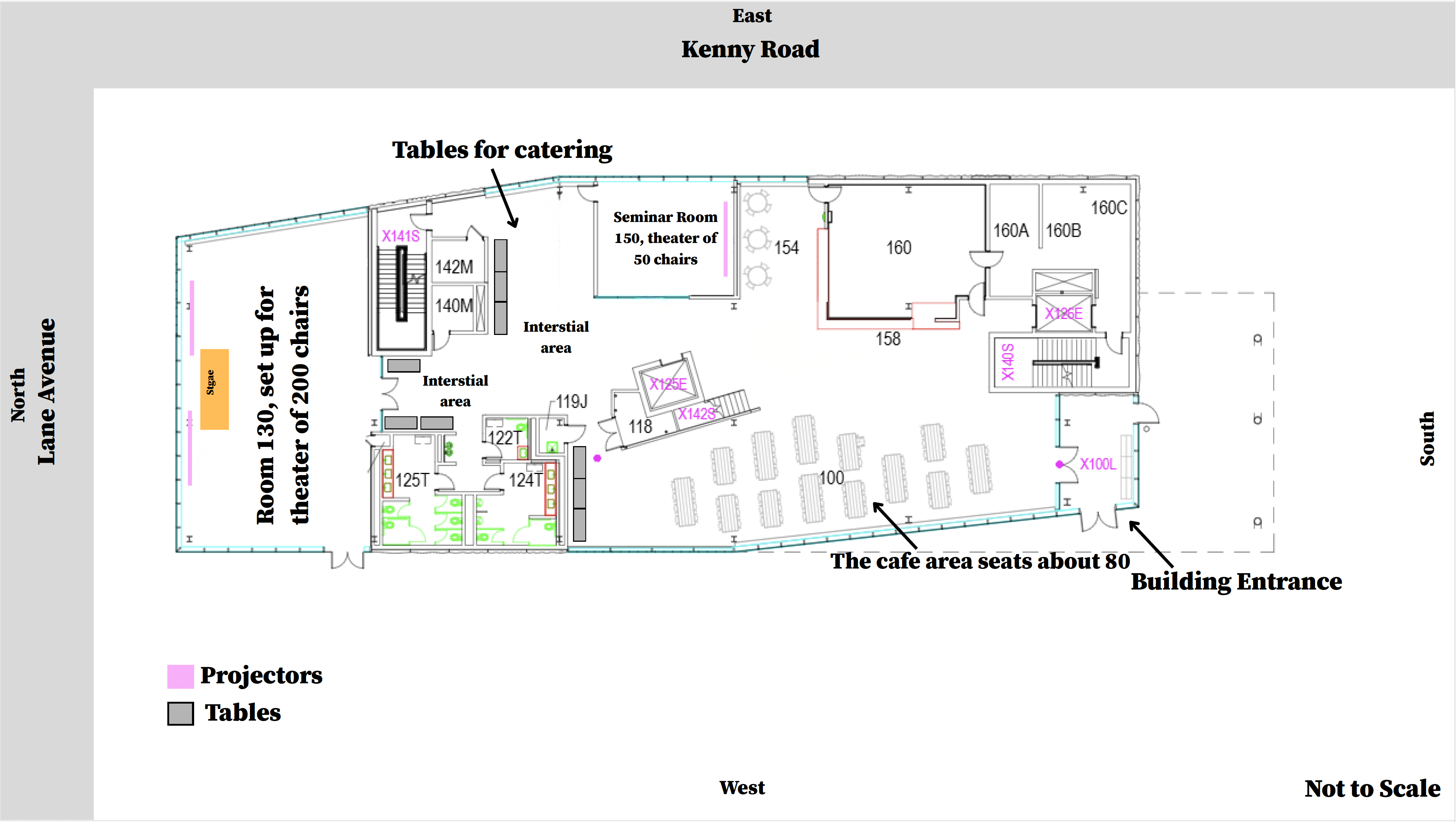
EAIC Floor 1
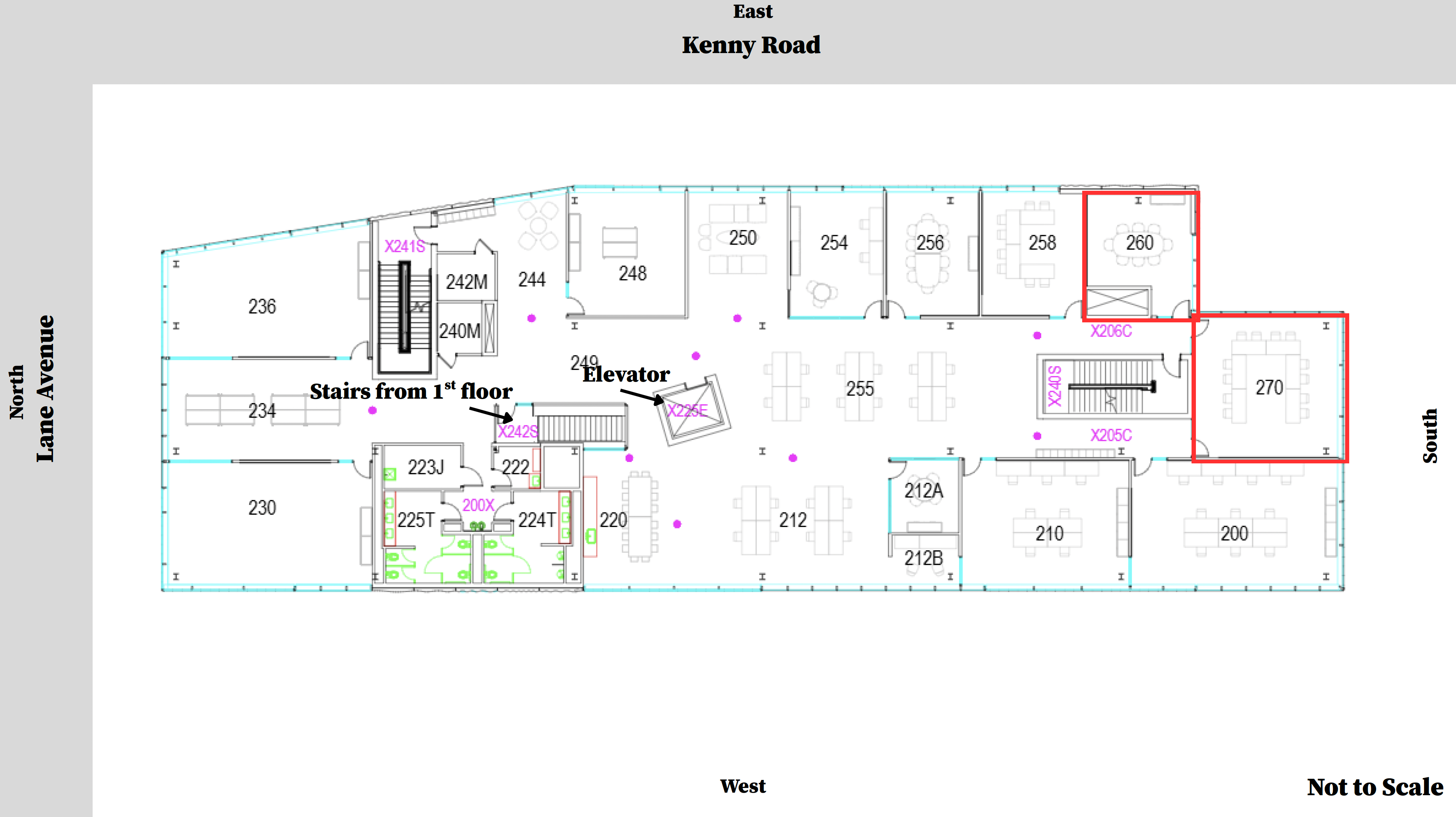
EAIC Floor 2
Detailed Program
Wednesday June 3
Session 1A: Bandits and Online Learning (08:30AM - 9:50AM)
Chair: Arnob Ghosh (New Jersey Institute of Technology)
- Age-Optimal Best Arm Identification
Mengqiu Zhou (Zhejiang University, China); Le Yang and Vincent Y. F. Tan (National University of Singapore, Singapore); Meng Zhang (Zhejiang University, China) - Probe-then-Commit Multi-Objective Bandits: Theoretical Benefits of Limited Multi-Arm Feedback
Ming Shi (University at Buffalo, USA) - Fair Online Learning for Restless Bandits
Tasmeen Zaman Ornee (The Ohio State University, USA); Arnob Ghosh (New Jersey Institute of Technology, USA); Ananthram Swami (DEVCOM Army Research Laboratory, USA); Ness B. Shroff (The Ohio State University, USA) - An LP-based Sampling Policy for Multi-Armed Bandits with Side-Observations and Stochastic Availability
Ashutosh Soni (The Ohio State University, USA); Peizhong Ju (University of Kentucky, USA); Atilla Eryilmaz and Ness B. Shroff (The Ohio State University, USA)
Session 1B: Age of Information (11:30AM - 12:50PM)
Chair: Yin Sun (Auburn University)
- Using Age of Information for Throughput Optimal Spectrum Sharing
Hongjae Nam, Vishrant Tripathi and David Love (Purdue University, USA) - Version AoI Optimization under Power and General Distortion Constraints in Uplink NOMA
Gangadhar Karevvanavar (IIT Dharwad, India); Rajshekhar Vishweshwar Bhat (Indian Institute of Technology Dharwad, India); Nikolaos Pappas (Linköping University, Sweden) - Beyond Freshness and Semantics: A Coupon-Collector Framework for Effective Status Updates
Youssef Ahmed (The Ohio State University, USA); Arnob Ghosh (New Jersey Institute of Technology, USA); Chih-Chun Wang (Purdue University, USA); Ness B. Shroff (The Ohio State University, USA) - Age of Estimates: When to Submit Jobs to a Markov Machine to Maximize Revenue (Invited paper)
Sahan Liyanaarachchi and Sennur Ulukus (University of Maryland, USA)
Session 1C: Emerging Topics: Quantum, Haptic Communication, and ISAC (02:30PM - 03:50PM)
Chair: Bin Li (The Pennsylvania State University)
- ISACSoil: Multi-Layer Soil Moisture Sensing with LoRa Cross-Soil Communication
Yawen Wang, Yimeng Liu and Jingkai Lin (Michigan State University, USA); Yidong Ren (Qualcomm, USA); Younsuk Dong and Tianxing Li (Michigan State University, USA) - Distributed Quantum Error Correction: Advancements and Future Research Directions (Invited paper)
Shahram Babaie, Sean Grzenda and Chunming Qiao (University at Buffalo, USA) - On the Analysis of a Quantum MDP Algorithm for Optimizing the Entanglement Throughput of Quantum Switches (Invited paper)
Bin Luo (The Chinese University of Hong Kong, Hong Kong); John Chi Shing Lui (Chinese University of Hong Kong, Hong Kong) - Predictive Hybrid Resource Scheduling for Haptic Traffic with Diffusion-Based Offline Reinforcement
Yu Yeh (CentraleSupélec, France); Georgios Kokkinis and Qi Zhang (Aarhus University, Denmark); Salah Eddine Elayoubi (CentraleSupélec, France); Vineeth S Varma (CRAN, CNRS, France)
Session 1D: Federated Learning (04:20PM - 05:40PM)
Chair: Haibo Yang (Rochester Institute of Technology)
- When the Server Steps In: Calibrated Updates for Fair Federated Learning
Tianrun Yu (The Pennsylvania State University, USA); Kaixiang Zhao (University of Notre Dame, USA); Cheng Zhang (North Carolina State University, USA); Anjun Gao (University of Louisville, USA); Yueyang Quan and Zhuqing Liu (University of North Texas, USA); Minghong Fang (University of Louisville, USA) - FedHusky: Accelerating Hybrid Federated Learning with Client Hopping
Fangtong Zhou, Yi Shi, Wenjing Lou and Thomas Hou (Virginia Tech, USA) - Privacy-Accuracy Trade-offs in Federated Learning with Data and Privacy Heterogeneity
Po-Yen Chen (University of Michigan - Ann Arbor, USA); Nick Farid and Mingyan Liu (University of Michigan, USA) - Communication-Efficient State Synchronization for Stable Second-Order Federated Learning
Ahmed Hany, Karim A. Banawan, Nourhan Sakr and Karim G. Seddik (American University in Cairo, Egypt); Tamer ElBatt (The American University in Cairo (AUC), Egypt)
Thursday June 4
Session 2A: Edge Computing and Offloading (08:30AM - 9:50AM)
Chair: Brocanelli Marco (The Ohio State University)
- Delay Optimization in a Simple Offloading System
Darin Jeff (Massachusetts Institute of Technology, USA); Eytan Modiano (MIT, USA) - PROTEUS: Proactive Latency-Constrained Enhanced Ubiquitous Surveillance
Gaurav Singh (The University of Texas Arlington, USA); Arnob Ghosh (New Jersey Institute of Technology, USA); Debashri Roy (The University of Texas Arlington, USA) - HOSL: Hybrid-Order Split Learning for Memory-Constrained Edge Training
Aakriti Lnu, Zhe Li and Dandan Liang (Rochester Institute of Technology, USA); Chao Huang (Montclair State University, USA); Rui Li and Haibo Yang (Rochester Institute of Technology, USA) - Structure-Informed Online Bandwidth Allocation for Heterogeneous Real-Time Synchronized Streaming
Xuan Wang (Pennsylvania State University, USA); Ying Sun (The Pennsylvania State University, USA); Atilla Eryilmaz (The Ohio State University, USA); Bin Li (The Pennsylvania State University, USA)
Session 2B: Resource Allocation and Network Optimization (11:30AM - 12:50PM)
Chair: Ziyue Luo (The Ohio State University)
- Learning Utility over Black-Box Underlays with Delayed Feedback
Md Mahfujul Kadir and Ning Lu (Queen's University, Canada) - Utility Maximization in Wireless Backhaul Networks with Service Guarantees
Nicholas W Jones and Eytan Modiano (MIT, USA) - Planning for Reliable Multi-Technology Networks Under QoS Guarantees
Maria Samonaki (Technical University of Munich, Germany); Nicolai Kröger (Technical University of Munich (TUM), Germany); Fidan Mehmeti (Technical University of Munich, Germany); Wolfgang Kellerer (Technische Universität München, Germany); Carmen Mas-Machuca (University of the Bundeswehr Munich (UniBW), Germany) - Bi-Level Online Provisioning and Scheduling with Switching Costs and Cross-Level Constraints
Jialei Liu (State University of New York at Buffalo, USA); Can Emre Koksal (The Ohio State University, USA); Ming Shi (University at Buffalo, USA)
Session 2C: 5G/6G and Beyond (02:30PM - 03:50PM)
Chair: Ming Shi (University at Buffalo (SUNY))
- Priority-Aware Encoding for Bandwidth-Efficient Real-Time Classification in 5G Networks
Chengzhang Li (The Ohio State University, USA); Peizhong Ju (University of Kentucky, USA); Atilla Eryilmaz and Ness B. Shroff (The Ohio State University, USA) - Interference Prediction and Beam Alignment in 5G Indoor mmWave UDNs
Sihyun Choi and Sungbo Eo (Seoul National University, Korea (South)); Changhee Joo (Korea University, Korea (South)); Saewoong Bahk (Seoul National University, Korea (South)) - SpikeCSI: CSI Feedback Compression for MIMO Wireless Systems using Spiking Neural Networks (Invited paper)
Eduardo David Lotto and Eleonora Cicciarella (University of Padova, Italy); Francesco Restuccia and Francesca Meneghello (Northeastern University, USA) - Mobile Distributed MIMO for 6G: Learning Meets Coherent Joint Transmission (Invited paper)
Usama Saeed, Ramin Safavinejad, Yibin Liang, Karim Said, Daniel Jakubisin and Lingjia Liu (Virginia Tech, USA)
Session 2D: Semantic and Efficient Communications (04:20PM - 05:40PM)
Chair: Quanyan Zhu (New York University)
- Adaptive Unicast-Multicast Strategies for Over-the-Air Updates in Multi-Receiver Wi-Fi Networks
Fatemeh Jafari and Valentin Thomas Haider (Technical University of Munich, Germany); Luca Parolini and Christian Wimmer (BMW Group, Germany); Fidan Mehmeti (Technical University of Munich, Germany); Wolfgang Kellerer (Technische Universität München, Germany) - TopoCode-PCD: Topological Semantic Error Detection and Correction for Geometric Point Cloud Communication
Rohit Bhusal, Hongzhi Guo and Mehmet Can Vuran (University of Nebraska-Lincoln, USA) - Joint Bit-Partitioning and Modulation Design for Digital AirComp
Xiaojing Yan and Carlo Fischione (KTH, Sweden) - Measure Once, Train Often: Scaling Waveform Classifiers with Channel-Augmented Data (Invited paper)
Sage Trudeau (Lincoln Laboratory, USA); Spencer Chun (MIT Lincoln Laboratory, USA); Brandon Nguyen and Kaushik Chowdhury (University of Texas at Austin, USA)
Friday June 5
Session 3A: Network Control and Scheduling (08:30AM - 9:50AM)
Chair: Vishrant Tripathi (Purdue University)
- Learning and Rate-Adaptive Scheduling in Wireless Networks with Unknown Channel Statistics (Invited paper)
Saptarshi Mandal (University of Illinois Urbana-Champaign, USA); R. Srikant (University of Illinois at Urbana-Champaign, USA) - Index Policies for RMAB Problems with Varying Capacity and Global State Dependency (Invited paper)
Sixiang Zhou (Purdue University, West Lafayette, USA); Xiaojun Lin (The Chinese University of Hong Kong, Hong Kong); Lei Jiao (University of Oregon, USA) - Optimal Sampling and Actuation Policies of a Markov Source over a Wireless Channel (Invited paper)
Mehrdad Salimnejad (Linköping University, Sweden); Anthony Ephremides (University of Maryland, USA); Marios Kountouris (University of Granada, Spain & EURECOM, France); Nikolaos Pappas (Linköping University, Sweden) - Monitoring State Transitions in Markovian Systems with Sampling Cost
Kumar Saurav (Shiv Nadar University, India); Ness B. Shroff and Yingbin Liang (The Ohio State University, USA)
Session 3B: Reconfigurable Intelligent Surface (11:30AM - 12:50PM)
Chair: Myeung Suk Oh (The Ohio State University)
- Cooperative Deep Reinforcement Learning for Fair RIS Allocation
Martin Mark Zan and Stefan Schwarz (TU Wien, Austria) - Tractable Analysis of Realistic Gains from Intelligent Metasurfaces
Santos Bustos Julian Alfonso and Jean-Marc Kelif (Orange Labs, France); Lynda Zitoune (L2S Paris Saclay University, France); Eitan Altman (INRIA, France) - Secure and Efficient Transmission in Hybrid Sparse RIS-Enabled Internet of Robotic Things
Gaurav Singh (The University of Texas Arlington, USA); Sravani Kurma (Mississippi State University, USA); Debashri Roy (The University of Texas Arlington, USA); Vini Chaudhary (Mississippi State University, USA) - Optimal RIS Placement in Multi-User MISO Systems with User Randomness
Abhishek Rajasekaran, Mehdi Karbalayghareh, Xiaoyan Ma, David Love and Christopher G. Brinton (Purdue University, USA)
Session 3C: Network Economics and Incentives (02:30PM - 03:50PM)
Chair: Jia Liu (The Ohio State University)
- Assuring Service Level Agreements in Open Radio Access Networks: An End-to-End System Design
Yufan He (Zhejiang University, China); Tuan Van Ngo, Mao Van Ngo, Binbin Chen and Tony Q. S. Quek (Singapore University of Technology and Design, Singapore); Howard Yang (Zhejiang University, China & University of Illinois at Urbana Champaign (UIUC), USA) - Contract Design for Dynamic Spectrum and Infrastructure Sharing under Asymmetric Risk Information
Zongyun Xie and Randall A Berry (Northwestern University, USA) - Internet of Agentic AI: Incentive-Compatible Distributed Teaming and Workflow
Ya-Ting Yang and Quanyan Zhu (New York University, USA) - Joint Network-and-Server Congestion in Multi-Source Traffic Allocation: A Convex Formulation and Price-Based Decentralization
Tamoghna Sarkar and Bhaskar Krishnamachari (University of Southern California, USA)
Session 3D: Learning for Wireless Systems (04:20PM - 05:40PM)
Chair: Peizhong Ju (University of Kentucky)
- Cells on Autopilot: Adaptive Cell (Re)Selection via Reinforcement Learning
Marvin Illian (Paderborn University, Germany); Ramin Khalili (Huawei Technologies, Germany); Antonio A. de A. Rocha (Fluminense Federal University, Brazil); Lin Wang (Paderborn University, Germany) - Physics-Informed Parametric Bandits for Beam Alignment in mmWave Communications
Hao Qin, Thang Nhat Duong, Ming F. Li and Chicheng Zhang (University of Arizona, USA) - AWaRe-SAC: Proactive Slice Admission Control under Weather-Induced Capacity Uncertainty
Dror Jacoby (Tel Aviv University, Israel); Yanzhi Li (Northwestern University, USA); Shuyue Yu (Columbia University, USA); Nicola Di Cicco (OPTIT, Italy); Hagit Messer (Tel-Aviv University, Israel); Gil Zussman (Columbia University, USA); Igor Kadota (Northwestern University, USA) - Learning Wireless Interference Patterns: Decoupled GNN for Throughput Prediction in Heterogeneous Multi-Hop p-CSMA Networks
Faezeh Dehghan Tarzjani and Bhaskar Krishnamachari (University of Southern California, USA)